


Future-Proof Your Career: The 6 Essential AI Skills to Master by 2026
🕑 Article from : Monday 29 December 2025 - Last update : Monday 29 December 2025








Master the 6 essential AI skills for 2026: Prompt Engineering, RAG with Mistral, and AI agents. Stay ahead of the curve and future-proof your career now.
The AI revolution is moving fast. Today, knowing how to use ChatGPT is an advantage. By 2026, it will be the bare minimum. To stay competitive in a rapidly evolving professional landscape, we need to move beyond casual usage and master the tools that build, automate, and manage intelligent systems.
We have developed a unified blueprint summarizing the critical skills required for the near future. This infographic breaks down the essentials into two main pillars: Foundational Skills and Advanced Applications.
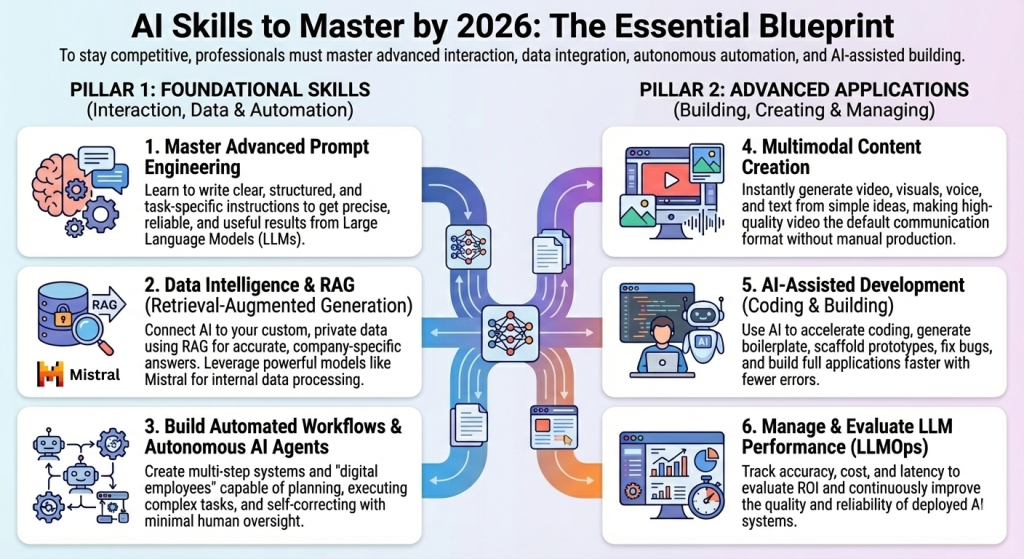
Here is a deep dive into the 6 key skills presented in our blueprint:
PILLAR 1: FOUNDATIONAL SKILLS (Interaction, Data & Automation)
These are the building blocks for effectively working with AI systems.
1. Master Advanced Prompt Engineering Talking to AI is becoming a new form of programming. It's not just about asking questions; it's about crafting precise, structured, and context-aware instructions. Mastering this skill ensures you get reliable, high-quality outputs from Large Language Models (LLMs) and avoid hallucinations.
2. Data Intelligence & RAG (Retrieval-Augmented Generation) Generic AI models know the internet, but they don't know your business. The crucial skill here is connecting AI to your private, proprietary data using RAG. This allows the AI to provide factual answers based on your internal documents.
-
Tool Highlight: Powerful, open-weight models like Mistral AI are excellent choices here, allowing companies to build secure, on-premise RAG systems without exposing sensitive data to third parties.
3. Build Automated Workflows & Autonomous AI Agents We are moving from chatbots to "agents." An agent doesn't just answer; it acts. Mastering this involves creating "digital employees" capable of planning multi-step tasks, executing them across different software, and even self-correcting when things go wrong, requiring minimal human oversight.
PILLAR 2: ADVANCED APPLICATIONS (Building, Creating & Managing)
These skills focus on leveraging AI to create value and build new products.
4. Multimodal Content Creation Content production is being democratized. Mastering multimodal AI means you can instantly generate high-quality video, images, voice, and text from a single idea. Video is rapidly becoming the default communication format, and AI makes producing it accessible without a studio budget.
5. AI-Assisted Development (Coding & Building) AI is not replacing developers; it is supercharging them. This skill is about using AI coding assistants to write boilerplate code faster, debug instantly, scaffold prototypes in minutes, and build robust applications with fewer errors.
6. Manage & Evaluate LLM Performance (LLMOps) Deploying AI is easy; managing it effectively is hard. As AI becomes critical infrastructure, professionals need "LLMOps" skills. This involves tracking accuracy, managing latency, controlling costs, and ensuring the ongoing reliability and ROI of deployed models.
Lead the AI Transformation Today
The landscape of 2026 will be defined by those who can effectively orchestrate these AI capabilities. Start building these foundational and advanced skills today to secure your place in the future of work.