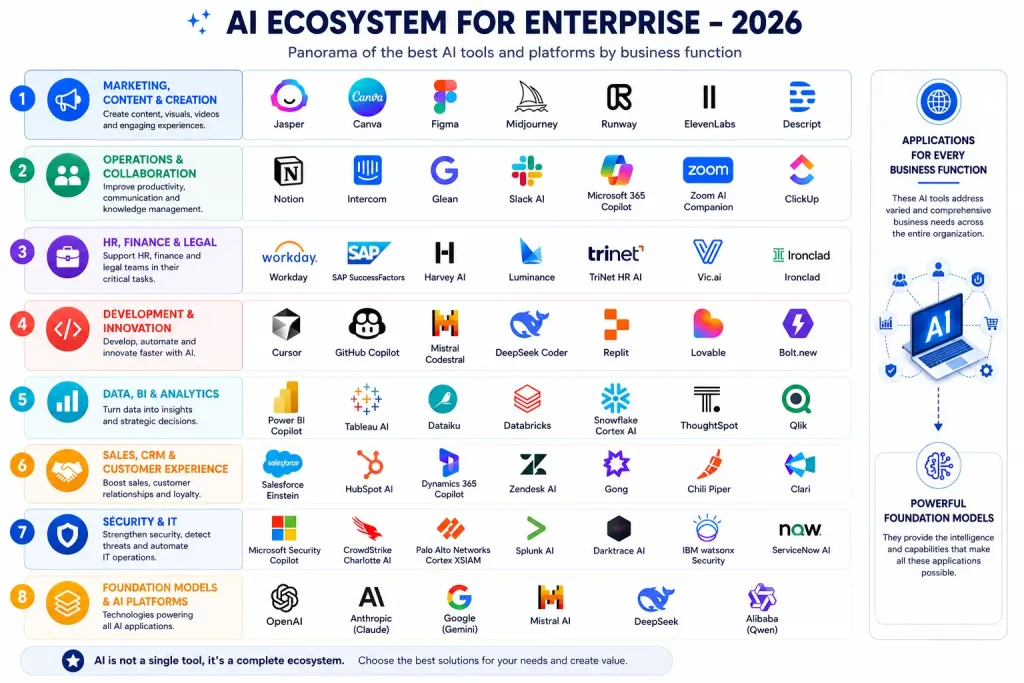
Enterprise AI Ecosystem 2026: The Ultimate Tool Guide
🕑 Article from : Wednesday 3 June 2026 - Last update : Saturday 13 June 2026








Discover our comprehensive 2026 mapping of the best AI tools for business. From marketing to BI, optimize your team's productivity with top enterprise solutions.
2026 Guide: Designing the Right AI Tool Ecosystem for Your Enterprise
The adoption of artificial intelligence in business has reached a decisive turning point. We have moved past simple technological curiosity into a phase of massive industrialization. Today, staying competitive means moving beyond general-purpose chatbots to structure a true AI tool ecosystem tailored to every business function.
To help you navigate your digital transformation, here is our comprehensive overview of the best AI applications for professionals, categorized by real-world business use cases.
1. AI Productivity Tools for Marketing and Content Creation
The historical core of generative AI has become highly professionalized, shifting from simple writing assistance to industrial-scale, multilingual content production.
-
Copywriting and SEO: Platforms like Jasper AI and Canva remain industry standards for automating ad campaigns and optimized content creation.
-
Professional Image Generation: Alongside Midjourney, the European open-source alternative FLUX.1 has established itself as a go-to for high-quality visuals that respect data sovereignty.
-
Video & Audio Production: Technologies from Runway (video generation) and ElevenLabs (voice cloning and voiceovers) now enable businesses to produce professional multimedia content at a fraction of the cost.
2. Operations & Collaboration: Integrating AI into Daily Workflows
Integrating an AI software solution into the heart of daily operations is the number one lever for boosting overall team productivity.
Knowledge Management & Collaboration
Tools like Notion AI and Glean are transforming internal knowledge management. They act as secure, centralized corporate search engines capable of instantly retrieving any piece of information hidden across your company's documents.
Customer Relations & Augmented CRM
Customer support no longer relies on rigid, scripted bots. Autonomous agents like Intercom Fin or Zendesk AI analyze customer history to resolve complex disputes fully autonomously and in multiple languages.
3. HR, Finance, and Legal: Automating Back-Office Functions
Specialized AI tools now provide the necessary rigor and compliance required for an enterprise's most critical back-office operations.
-
Lawtech & Legal: Solutions like Harvey AI (backed by OpenAI) or Europe’s Luminance analyze, compare, and audit complex, hundred-page contracts in seconds.
-
Fintech & Accounting: Vic.ai and Ramp automate invoicing pipelines, detect financial anomalies, and handle expense management predictively.
-
Human Resources: AI modules within Workday or SAP SuccessFactors streamline candidate sourcing and predictive internal skills management.
4. Data & Business Intelligence (BI): AI-Driven Decision Making
Data analysis is no longer reserved exclusively for Data Scientists. The integration of LLMs into Business Intelligence democratizes access to strategic insights.
AI connectors embedded in Power BI Copilot, Tableau AI, or enterprise data platforms like Databricks and Dataiku allow users to query complex databases using natural language. A manager can now generate a predictive report or a cross-tab chart simply by asking a text-based question.
5. Software Development: From Pro Coding to No-Code
Software engineering and business app innovation have been deeply disrupted by the rise of intelligent coding assistants.
-
For Developers: Environments like Cursor and GitHub Copilot accelerate code production, debugging, and architectural optimization.
-
The No-Code / Low-Code Boom: Platforms like Lovable or Bolt.new allow non-technical profiles to design, prototype, and deploy complex, functional business applications from a simple text prompt.
6. Cybersecurity & IT: Securing Corporate Infrastructure
To counter the rise of increasingly sophisticated cyber threats, IT security has armed itself with a layer of defensive artificial intelligence. Tech leaders like CrowdStrike, Splunk AI, and Palo Alto Networks deploy autonomous agents capable of monitoring networks, detecting anomalous behavior, and blocking complex attacks in real time.
7. Foundation Models: The Geopolitical LLM Race
All these professional applications rely on the computing power and reasoning capabilities of the foundation models (LLMs) driving them behind the scenes. In 2026, three major technological blocs are competing:
-
The United States (Raw Power): Led by the advanced reasoning capabilities of OpenAI (GPT-4o/o1), Anthropic (Claude), and Google (Gemini).
-
Europe (Sovereignty and Compliance): Headheaded by France's Mistral AI, highly favored by enterprises focused on data privacy and strict GDPR compliance.
- <p">Asia (Economic Efficiency): Driven by the sudden rise of DeepSeek and Alibaba's Qwen models, which are disrupting infrastructure costs while delivering top-tier performance.
Conclusion: How to Succeed in Your AI Strategy
The ultimate mistake in 2026 would be searching for a single "all-in-one" tool. The key to a successful digital transformation lies in interoperability.
An agile enterprise must select the best vertical applications for its specific business units and connect them via secure APIs to its internal data and the most efficient foundation models. AI is no longer an isolated software app; it is the new operating system for your business productivity.