


How to Choose a Domain Name in 2026? Complete Guide
🕑 Article from : Friday 12 June 2026 - Last update : Monday 15 June 2026








2026 domain name guide: 7 golden rules, mandatory checks (history, trademarks, social media), renewal price traps. Infographic and FAQ. How to Choose a Domain Name in 2026? Complete Guide

How to Choose a Domain Name in 2026? Complete Guide
You want to create a website, a blog or an online store. The first step – and one of the most important – is to choose your domain name. It’s your address on the web. What your visitors type into their browser. It’s also your identity and your brand.
But how do you make the right choice? Too short, too long, with numbers, an unknown extension… Mistakes are common.
In this guide, I give you the 7 golden rules, a complete checklist of checks to do, and a 6‑step infographic so you don’t forget anything.
What is a domain name? Why is it essential?
A domain name is the unique address of your website on the Internet. For example: mysite.com or mybusiness.fr.
Without a domain name, you would have an address like: http://192.168.1.1/~mypseudo or myproject.wordpress.com. Not very professional, hard to remember, and bad for SEO.
A domain name gives you:
-
Your digital identity
-
Credibility with visitors
-
A key element for your marketing strategy (it will be on your business cards, emails, social media)
-
A (modest but real) SEO factor
Difference between a domain name and a subdomain
A subdomain is an additional part placed before your domain name. For example: blog.mysite.com or shop.mysite.com.
When to use a subdomain?
-
For a test site (test.mysite.com)
-
For a specific service (support.mysite.com, mail.mysite.com)
-
To separate very different sections of the same site
Can a subdomain be enough for a project? Yes, if you are starting with a free solution (e.g. myproject.wordpress.com). But for a professional or serious project, invest in a real domain name. It’s more credible and you stay in control of your address.
The 7 Golden Rules for Choosing a Good Domain Name
Here are the absolute rules to make your name effective, memorable and professional.
1. Short – less than 15 characters
The longer the name, the harder it is to remember and type without mistakes. Aim for 10–12 characters max. Avoid long names.
✅ thebest.fr
❌ thebestproductsin theworld.com
2. Simple – no numbers, no hyphens
Numbers cause confusion (5 or five? 4 or for?). Hyphens are often forgotten or misplaced. Use letters only.
✅ quick.fr
❌ quick-24-7.com
3. Easy to pronounce – the radio test
Say your name out loud. If you have to spell it or correct the person in front of you, it’s bad. Imagine you say it on the radio: the listener should be able to write it without hesitation.
✅ sunset.fr
❌ szkylight.fr (impossible to pronounce)
4. Easy to spell – no spelling traps
Avoid homophones (sea/see), unnecessary double consonants, silent letters.
✅ photostudio.fr
❌ phothostudio.fr (intentional misspelling)
5. Memorable – stays in mind
A good name creates an image, an emotion, or a simple pun. Avoid random letter sequences.
✅ redfox.fr
❌ <code">xqztnl.fr
6. Unambiguous – avoid awkward double meanings
Read your name again. A bad combination can give an unintended or funny meaning.
Famous example: penisland.net (intended as "Pen Island", but read as something else). Be careful.
7. Future‑proof – not too restrictive
If you sell women’s shoes today, don’t choose womenshoes-paris.fr. Tomorrow you might want to add accessories or expand to other cities. Prefer a broader brand name.
✅ stepone.fr
❌ womenshoes-paris-17th.fr
Brand strategy: your name will be everywhere
Your domain name does not live alone. It will appear:
-
On your business cards
-
In your email signatures
-
On your social networks
-
In your ads
So check the availability of the handle on major social networks (Twitter, Instagram, LinkedIn, TikTok, Facebook). Ideally, have the same name everywhere.
Consistency: your domain name should match your company name, product name or main pseudonym. Don’t create confusion.
Not too restrictive: as said above, leave room to expand your activity.
Mandatory checks before you commit
Don’t rush. Before buying, do these 4 checks.
1. Name availability
Check that the name is not already taken. A domain name can be registered even if no website is accessible. Use a verification tool like Flexisite or Namecheckr.
If the name is taken, note possible variations (change the extension, add a word, etc.).
2. Domain history (for a previously used domain)
If the domain already belonged to someone else, check its past. Was it used for spam, illegal content, or penalised by Google? Use:
-
Wayback Machine (archive.org) to see old content
-
Tools like Moz or Ahrefs (limited free version) to check toxic backlinks.
A bad history can ruin your SEO.
3. No conflict with a registered trademark
Don’t choose a name that is already a registered trademark, especially if you are in the same industry. This could lead to a lawsuit and loss of your domain.
-
In France: check the INPI database
-
Internationally: USPTO (USA) or WIPO (global)
4. Availability on social networks
As said above, check that the handle (or a close version) is free on Twitter, Instagram, Facebook, LinkedIn, TikTok, etc. So you have a consistent identity.
Practical aspects (in brief)
A domain name is paid for a fixed period (usually 1 year) and renewable.
The average price for a .com is €12–15 ex. VAT/year, .fr is slightly cheaper. But some extensions can be much more expensive (up to several hundred euros).
Watch out for misleading promotions. Some providers offer a very low price the first year, then a higher price afterwards. To avoid being caught out, always check the renewal price before buying.
Frequently Asked Questions (FAQ)
Should I include a keyword in my domain name?
In the past, this was very important for SEO. Today, the impact is low. If the keyword fits naturally without making the name too long, why not. But don’t sacrifice your brand for a keyword.
✅ paris-bikes.fr (acceptable, clear)
❌ best-electric-bike-paris-cheap.fr (too long, too keyword‑stuffed)
Does domain age affect SEO?
Yes, a little. An older domain inspires more trust in Google than one created yesterday. But good content and a good link building strategy can catch up. Don’t pay a lot for an old domain just for its age, unless it already has a good backlink profile.
What if my ideal name is already taken?
Several options:
-
Add a small word: mybrand.com → mybrandofficial.com (avoid if possible)
-
Change the extension: .com taken → .fr, .co, .io (be consistent)
-
Negotiate with the current owner (via services like Sedo) – expensive and risky
-
Join an auction if the domain expires (sites like GoDaddy Auctions)
-
Change your name completely (sometimes the best solution)
Should I buy multiple extensions (e.g. .com, .fr, .net)?
This is a topic on its own. In short:
-
Brand protection: yes, if you have the budget, at least get .com and your country’s extension (.fr for France).
-
Small personal blog: unnecessary.
-
Business: recommended to prevent a competitor from taking the same name in .net or .org.
I will detail this in a future article dedicated to extensions.
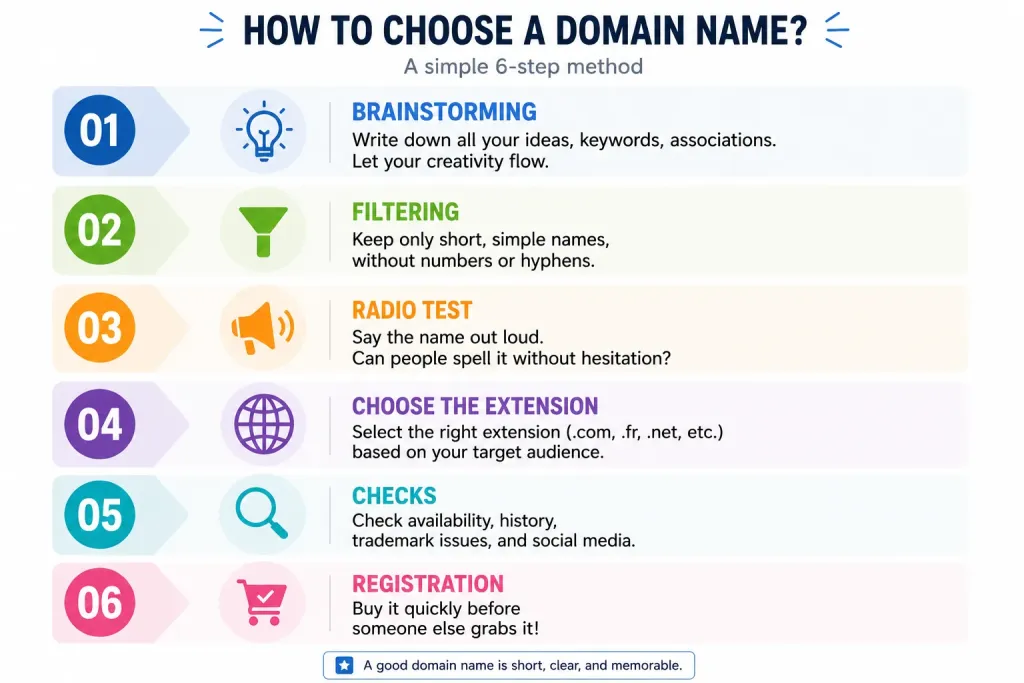
Infographic: 6 steps to choose your domain name
Here is a simple step‑by‑step method. You can reproduce it as an image or just keep it as a checklist.
Choosing a domain name: what to remember
Choosing a domain name is not complicated, but you shouldn’t do it lightly. Your domain name is your address, your brand, your first impression.
Key points:
-
Short, simple, no numbers, no hyphens
-
Easy to pronounce and spell (radio test)
-
Check availability, history, trademarks, social media
-
Beware of renewal prices
-
Choose a reliable registrar
Now what?
Stop searching: go check if your preferred name is free. If it is, reserve it quickly. Good names go fast.
Coming soon: In a next article, we’ll detail how to choose the best extension (.com, .fr, .io, .ai, .shop, etc.) and whether you should buy several to protect your brand.